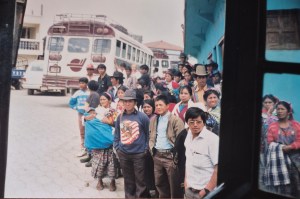
This photo shows family members waiting for the buses of returning refugees. They are hoping to reunite with a long, lost loved one.
Bill and I have completed our training as Accompaniers and are on board buses of refugees heading for their new home in Guatemala. The excerpt below from my book gives you a snapshot of the training that we had.
Vulnerable. Powerless. Afraid. These feelings surged through me as I lay spread-eagled, face-down in the lumpy grass. The harsh voice growled yet again, “Stay down. Don’t move. Or else.”
Danger clothed in a military uniform and armed with a rifle. As I lay in the grass with the others, I felt that rifle waving a threat over us. I and my companions had been having a meeting in a community hall when a surly bunch of uniformed men had exploded into the room and ordered us all outside at gunpoint.
The rifle was wooden. Fake. The uniformed soldiers were Canadians, men and women, fellow budding Accompaniers. We were in the midst of a role play on Day Four or our one-week training. This was one of several role plays that comprised our camp training on an abandoned farm on Salt Spring Island. The training was organized by our local Christian Task Force on Central America, and Bill and I felt blessed to be able to attend it right in our own backyard. Furthermore, the head trainer was Canadian Karen Ridd, an experienced social activist who had been jailed in El Salvador during the civil war in that country. What better way, we thought, to get prepared to deal with the realities of what we would encounter as Accompaniers when we reached Guatemala. The overt violence of the war had ceased, and the refugees had started their organized, dignified Returns to their home country. However, the Peace Accords would not be signed for a few years. Intimidation and danger were still a reality for the refugees. We international Accompaniers were living life insurance for these determined but vulnerable men, women, and children.
Why role plays?
They were essential for three reasons – to discover ourselves, to understand those whom we would encounter, and to aid our trainers in determining our suitability for the job. They were designed to simulate stressful situations that we might encounter – military roadblocks, intimidation, interrogation, abusive language, pushing, shoving of refugees, machismo sexism.
Question: Have you ever taken part in a role play? Did it change you in any way? How?
 Lindabrierly.com
What are your thoughts?