Author: Linda

  • The Pause that Refreshes

    Half way through January of 2026 already!

    Here in Clearwater the days are short and mostly dark. Snow covers the ground, and due to mild winter temperatures, driving and walking present challenges – ice or slush or fog or snow buffeting eyes and windshields.

    Another challenge I personally have been facing is STAGNATION. Another way of describing it could be STUCK AND CAN’T GET MOVING. The reason? Not sure. Could be lack of sunshine with its welcome dose of Vitamin D. Or it could be post-busy-holiday syndrome. I don’t think it is LAZINESS. My usual challenge in life is to SLOW DOWN, not to GET GOING FOR GOODNESS SAKE.! So this season for me is a CONUNDRUM.

    Rather than STRIVE and make things happen (my usual way of handling life), I have decided to REST, PAUSE, and wait for the God of the Bible to nudge me into action when He figures its time. I feel that I have a close enough relationship with Him to trust Him in this. So this will be my last blog post for awhile.

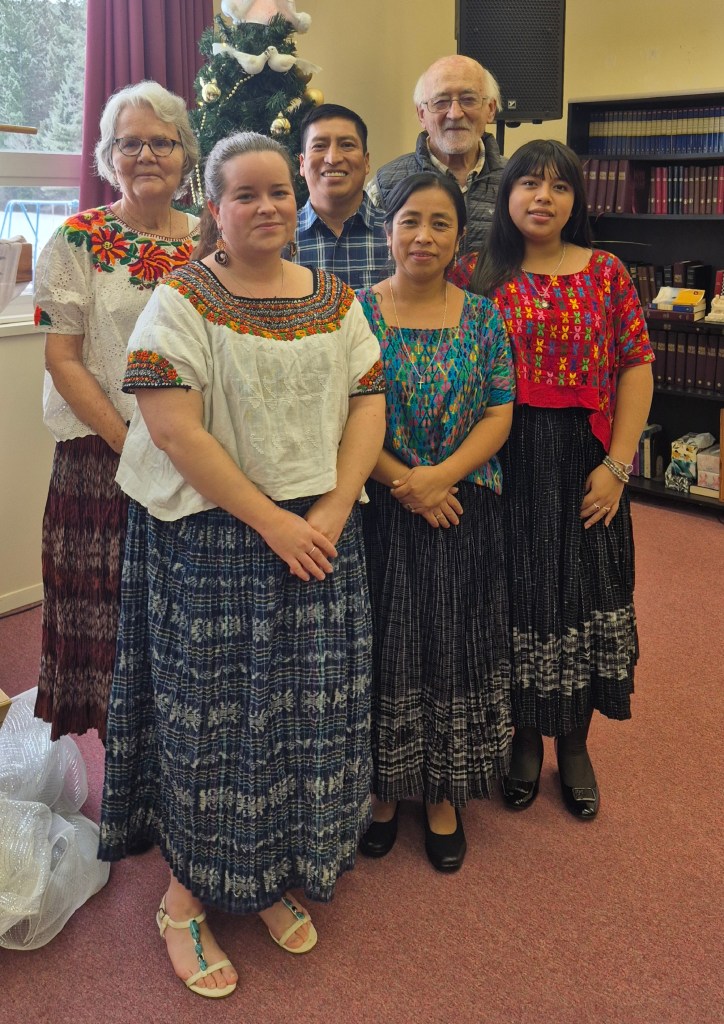
    But before I sign off , I will end on a HIGH NOTE, one that brought LAUGHTER and LIGHT into our Christmas season. It was the ten-day visit of our special Pokomchi family from Guatemala – Glenda, Sebastian, and Juanita. Also included was our full-time missionary there, Rebekah, who is a precious part of our ministry family.

    Below is our Christmas photo to feast your eyes on. I invite you to get acquainted with them in the last section of my book – Bill, Me, and the Pokomchi.

    Blessings on us all as we advance minute by minute and day by day into 2026.
  • Feet on the Ground

    Comitan, Mexico, mid-1990’s

    Excerpt from my book:

    Shoes pounding the pavement in the street outside our window. Explosions ripping the stillness of the night. Then a loud, insistent banging on the outside door of the courtyard.

    “We are under attack!” I exclaimed. “NOW what do we do?”

    “We’ve got to think,” replied Bill. “Stay calm and think rationally.”

    This was our first night in-country as new Accompaniers. We had stepped off a bus earlier that day from Mexico City.

    “Here is the name of the hotel they recommended,” I said to Bill as I extracted a slip of paper from my fanny pack.

    Project Accompaniment had assured us that the hotel was safe, clean, and modest. In typical Latin style, it was surrounded by a high wall, had a courtyard, and two thick, sturdy wooden doors that were closed and bolted after dark. Shortly after checking in, we had crawled into bed in our second-floor room, our backpacks propped up against the far wall. We were travel-weary but felt safe and ready for a restorative night’s sleep.

    “Tomorrow our adventure really begins,” I murmured to Bill, as a frisson of excitement flitted through my fatigue.

    The alarming ruckus propelled us out of bed. Fear coursed through our veins. Bill climbed up on a wooden chair and peered out the high window to see what was going on. Stay calm, scope out the situation, then make an appropriate non-confrontational plan of action. We reminded ourselves what our training had drummed into us. We didn’t have to talk about it. We acted instinctively.

    Drat it! All he could see was the thick, high wall of our hotel. We couldn’t find out what was going on out there. We realized we had no control over it anyway.

    “It sure sounds ominous!” remarked Bill as he jumped down from the chair. “I wonder if guerilla forces are attacking the city.”

    “But we’re still in Mexico, not Guatemala,” I said. “That doesn’t make any sense.”

    We decided to put our efforts into what we did have control over. Calming down with deep breaths, we pulled on our street clothes. We packed and closed our backpacks, ready for action. Then we waited to see what would happen next.

    We waited the rest of the night. No one came to our door. No sounds from anywhere inside the hotel or the courtyard. It was an oasis of calm and quiet. Would it stay that way? Would we stay safe here? Would the turbulent upheaval of law and order out on the streets pass us by, leave us unmolested? Or would the angry forces bang down the mighty hotel gates, surge in like a horde of devouring locusts and take us captive? Would we ever get to be Accompaniers and help our vulnerable brothers and sister restore their lives to calm and dignity?

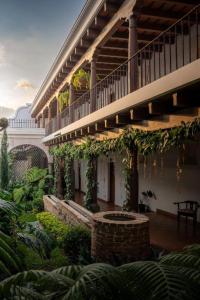
    Photo below is similar to our hotel.

    To find out what happened, I invite you to purchase my book from one of the sources in the About the Book section of my website: lindabrierly.com

    What are your thoughts?

  • Training Days

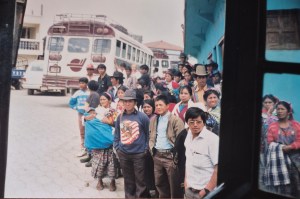
    This photo shows family members waiting for the buses of returning refugees. They are hoping to reunite with a long, lost loved one.


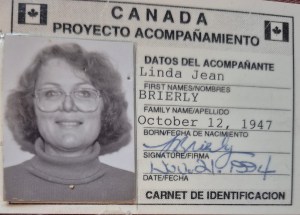
    Bill and I have completed our training as Accompaniers and are on board buses of refugees heading for their new home in Guatemala. The excerpt below from my book gives you a snapshot of the training that we had.


    Vulnerable. Powerless. Afraid. These feelings surged through me as I lay spread-eagled, face-down in the lumpy grass. The harsh voice growled yet again, “Stay down. Don’t move. Or else.”

    Danger clothed in a military uniform and armed with a rifle. As I lay in the grass with the others, I felt that rifle waving a threat over us. I and my companions had been having a meeting in a community hall when a surly bunch of uniformed men had exploded into the room and ordered us all outside at gunpoint.

    The rifle was wooden. Fake. The uniformed soldiers were Canadians, men and women, fellow budding Accompaniers. We were in the midst of a role play on Day Four or our one-week training. This was one of several role plays that comprised our camp training on an abandoned farm on Salt Spring Island. The training was organized by our local Christian Task Force on Central America, and Bill and I felt blessed to be able to attend it right in our own backyard. Furthermore, the head trainer was Canadian Karen Ridd, an experienced social activist who had been jailed in El Salvador during the civil war in that country. What better way, we thought, to get prepared to deal with the realities of what we would encounter as Accompaniers when we reached Guatemala. The overt violence of the war had ceased, and the refugees had started their organized, dignified Returns to their home country. However, the Peace Accords would not be signed for a few years. Intimidation and danger were still a reality for the refugees. We international Accompaniers were living life insurance for these determined but vulnerable men, women, and children.

    Why role plays?

    They were essential for three reasons – to discover ourselves, to understand those whom we would encounter, and to aid our trainers in determining our suitability for the job. They were designed to simulate stressful situations that we might encounter – military roadblocks, intimidation, interrogation, abusive language, pushing, shoving of refugees, machismo sexism.


    Question: Have you ever taken part in a role play? Did it change you in any way? How?

    What are your thoughts?

  • Shocking Injustices

    While living on Salt Spring Island, we joined an activist group. Through this group we learned about a thirty-year civil war in the Central American country of Guatemala. We learned about a shocking genocide which targeted primarily the indigenous people.

    We felt compelled to put our outrage and horror into action. We became Project Accompaniers.

    This leads into the following excerpt from my book:

    “We learned that those indigenous Mayans were literally pushed into exile by the brutal repression making life unbearable. Most had only the clothes on their backs. Many expected they would remain only a few days or at the most several months. They longed to return to their homeland. However, as the war rage on, they had to face reality. In response, with the help of the Mexican government, they built refugee camps. These were literally villages carved out of the Mexican jungle, equipped with make-shift schools and clinics. They formed camp governments and, with help, became politically aware and empowered. They began to forge their destiny. Their destiny was an organized Return on their terms. In the late 1980s, they published the six conditions they demanded. One of these demands was the right to be accompanied in their Return by international and national groups.

    Enter, Project Accompaniment, the Canadian response to Condition #6. It was a response to the refugees’ desire to return to their homeland in an organized fashion, accompanied every step of the way by international groups. They wanted the eyes, ears, cameras, and contacts of people and governments of the world on them. They had fled in secret, a horrendous secret. Their return would be open and public and dignified.”

    United Nations buses taking refugees home.

    Question for you:

    What injustices bother you a lot? What action have you taken or plan to take to put them right?

    What are your thoughts?

  • Butterfly Moment in the Yukon

    In the big city of Edmonton, we answered the ‘call of the wild’ and went to the Yukon. Less noise, less bustle, more solitude, and more of nature’s vastness. We lived there for five years.

    The pivotal moment for leaving the Yukon happened to us as Bill and I sat high on the banks of the Pelly River not far from Faro, deciding whether to go or stay. At that moment a yellow butterfly flitted up to us and hovered around us.

    We had just read a book called Hope for the Flowers by Trina Paulus. It is an inspiring allegory about the meaning of life as told through the lives of two caterpillars. Yellow and Stripe. They each try many caterpillar ways of finding this meaning. Eventually, Yellow found and climbed a caterpillar pillar, believing she was finally going to get there. However, when she reached the top, she discovered – nothing. It was then that she realized that her destiny as a caterpillar was to transform into a butterfly and fly. She found a branch, wove herself into a cocoon, and emerged as a beautiful yellow butterfly.

    How did this fulfill the meaning of life for her? Freedom. She had never experienced it. Purpose. As a butterfly, she helped flowers and fruit reproduce. Relationship. She needed the flowers to feed her. The flowers needed her to pollinate them.

    The book ends with Butterfly Yellow flitting over to Caterpillar Stripe to let him in the secret of his destiny.

    Being visited by that yellow butterfly at that precious moment clinched it for us. We we meant to go. Freedom. Purpose. Relationship. Down the road of our life, these vague concepts gradually became crystal clear. They transformed into sharp edges and definite shapes and deep meaning.

    Are you a caterpillar or a butterfly? What do you see as your destiny?

    What are your thoughts?

  • Time of Tears

    Here is the context of this adventure:

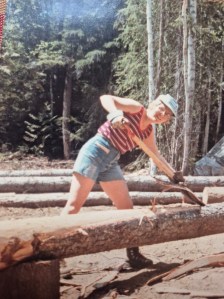
    We had moved to the ‘Promised Land’ – Canada. We bought property in Clearwater, BC and proceeded to build a log house. This episode takes place during the log house building.

    But I must mention the pivotal ‘Time of Tears’. My tears of frustration flowed abundantly when I hit a snag peeling the logs. Besides breadwinner, I was the main bark-peeler on the team. When I peeled the bark off the logs right after they were felled, it slid off easily. It was like peeling ripe bananas. However, what a shock I got when I started to peel the bark off the logs that had been sitting all winter! The bark would not budge. Frozen on the log as if stuck on with Gorilla Glue, it defied all my grunting, groaning efforts to lift it off. Now what to do? No peeled logs, no log house. Stumped. Sitting on one of the obstinate bark-covered logs, I put my head in my hands. I took big gulps of air, trying not to drown in despair. It seemed to me like the end of the road. The end of a dream.

    Now, as a mature Christian with an intimate, trusting relationship with Jesus, I would have stopped right there and prayed. I would have asked Jesus for His divine peace to replace my human despair. I would have waited in confident anticipation for His answer to my prayer. His perfect way out of my crisis. Alas! At that time, I was still in the driver’s seat of my life and Jesus was just my passenger. I felt it was totally up to me to overcome this hurdle. But Jesus was a sneaky passenger. He quietly reached over and put His hands over mine on the steering wheel. Turning the wheel ever so slightly, He got me through the crisis and back on track. It was not the end of the road, just a bend in the road to our dream.

    Of course, Bill and I assumed that the solution came about by our clever problem-solving and dogged persistence. Yes, in part that was true. But now, years later, with the hindsight of a deeper faith, I clearly see Jesus’ hands on the steering wheel.

    So how was the battle between stubborn bark and human determination finally won? Bill and I decided to seek advice.

    “Ken,” Bill said to our logger neighbor, “how do we peel the logs when the bark is frozen on?”

    Ken’s Matter-of-fact answer came readily. “A tiger torch. Blast the bark section by section, with the fiery heat of the propane torch. This thaws out the bark and, voila! The bark will peel off like the skin off a dead rabbit.”

    We did. And it did. It took more work and more time than with fresh logs, but we ended up with all the logs beautifully naked and ready to be made into a house.

    Question:

    What time in your life did you win the battle with a big obstacle? How did you do it? Who did you give the credit to?

    What are your thoughts?

  • Bad News Border

    In the photo above, on the left is a bus, on the right is a border agent.

    The context of this excerpt from my book is the following:

    Bill and I were on a bus traveling from Turkey to Austria. The bus had just left Bulgaria and entered Yugoslavia, where the usual visa checks were carried out before proceeding. Here is what happened:

    “William Brierly. William Brierly!”

    Uh oh, now what?” we wondered., as we saw the agent waving Bill’s passport in the air.

    “William Brierly no Yugoslavia. Need visa. No have visa. No Yugoslavia,” declared the man.

    The adrenaline coursing through our shocked beings shattered our peace, leaving it in broken shards at our feet.

    (To make a long story short, after much broken English discussion, Bill had to return to Bulgaria alone; I had to continue on to Austria alone. Yikes!)

    The story continues:

    Meanwhile, the other passengers had received their documents and boarded the bus. The driver was waiting for Bill and me, impatient to get going. We had two minutes to come up with a plan.

    “I will wait for you in Salzburg,” I said, “At the big Glockenspiel in the old town.”

    The bus driver tooted his horn. We hugged each other and I jumped on the bus. As I got to our seat and looked out the window, there was Bill standing all by himself, gazing dazedly at me. I pressed my face against the glass as tears streamed down my cheeks and dripped from my chin.

    The bus pulled away and Bill got smaller and smaller until soon he was out of sight.

    Here is a question to ponder:

    When something unexpected and horrible happens to you, what is your first reaction? Your second reaction? How do resolve it in the end?

    What are your thoughts?

  • No Tickets

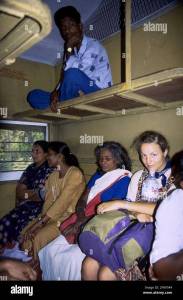
    We were in India traveling on a third class train. I took no photos on our westward journey, so I have searched out the photos for the next few posts, on the internet.

    We had just crossed the border from Nepal back into India. We were excited to have scored the luggage rack! That is the place where you see the man in the photo sitting. It was the deluxe spot on over-crowded third class Indian trains.

    Alas! The following excerpt from my book reveals an alarming surprise as we careened through the nighttime countryside.

    The conductor and his two guards had just entered our car and started checking the tickets of each passenger. This is what happened when he came to us:

    “No tickets?” the inspector asked in a pleasant tone. “No problem. I will sell you tickets right now.”

    “The thing is,” we explained to the friendly conductor, “we have no Indian rupees, only Nepalese rupees. We plan to buy Indian rupees in Varanasi and then pay for our train tickets.”

    “No rupees? No tickets and no rupees?” screeched the conductor. Uh oh, we thought, our hearts sinking. Like pulling a switch, the conductor’s friendly demeanor had changed to outrage and indignation. At the change, the armed guards stiffened, rifles snapping to attention. Gulp! Our reasonable explanation had fallen on deaf ears.

    The other passengers in the car became wide-eyed and alert. For them, a normally dull overnight train ride had suddenly gotten very interesting. They leaned forward in their seats eagerly taking in the drama unfolding before them. We had to come up with a Plan B fast! We held a whispered conference under the indignant eyes of the conductor and expectant stares of the other passengers.

    Bill rummaged in the little pouch nestled against his chest inside his shirt and pulled out our travelers’ checks. He stretched out his hand with the magic bits of paper, toward the conductor, an offering to placate an angry god. We held our breaths. The other passengers held their breaths. After scrutinizing the travelers’ checks in the dim light of the overhead bulb, the conductor nodded.

    “I will keep them until we arrive in Varanasi,” he said. “In the meantime, I am placing you under arrest,” he added.

    On a moving train? we wondered. Where does he think we would escape to, especially without our precious travelers’ checks?


    What would you do to placate an angry person – back down, fight back, try to mediate, or walk away?


    This is just one adventure you will read about in the thirty-eight chapters of my book.

    You can purchase EDGE OF THE LEDGE, A MEMOIR OF ADVENTURES LIVED AND LESSONS LEARNED at Friesen Press on-line Bookstore or Amazon.

  • EARTHQUAKE

    Bill (my Dream Man) and I met in the Safari Club in downtown Bangkok, Thailand. The next night Bill invited me on a date to an outdoor restaurant in a large wooded park. The excerpt below describes what happened during that date.

    “We all know about earthquakes. They are sudden, often devastating. They cause irrevocable changes where and when they strike. Life is one way before an earthquake, and another way after one. We cannot go back. We are told that the shifting of tectonic plates under the surface of the earth causes earthquakes. These shifts are not visible, often not even sensed by us, but they are real, not to be denied. I say this because it seems the best way to convey what happened to me that night, on my first date with Bill.

    While our external chatter was going on, an irrevocable shift started happening under my surface, the part of me that was not visible – emotions, will power, values, love. The solid ground of Me, Myself, and I started shifting and resettled into new terrain – Bill and Me Forever. By the end of that evening, the life I had before was gone, and a new life was born. I couldn’t deny it and I couldn’t go back.”

    You can purchase my book at Friesen Press on-line Book Store, Indigo.ca, or e-version from Amazon.

    After you have read it, please email me with your review, just a few sentences would do, at lindajbrierly@gmail.com.

    Thanks!

    What are your thoughts?

  • Unity in Diversity

    This is a HAPPY POST! For two reasons –

    -today’s excerpt from my book is heart-warming

    -my book is published and you can buy it!

    First here is the excerpt from my book:

    “Happy Birthday to you! Happy Birthday to you!”

    I joined in the singing with the Vietnamese family around the table. A glamorous cake sparkling with lit candles graced the spot in front of the ten-year-old birthday girl. Their dress and bearing revealed that they were rich city folks. Also, the fact that they sang in English. I did not know a single one of them.

    Five minutes previously, they had drawn me into their orbit with smiling ‘come hither’ gestures, pulling out a chair and patting the seat. I ate my piece of cake and then nodded and smiled as they chatted. Soon the party was over, and the birthday family rose from the table and swooped out of the restaurant, chattering like a flock of jays. I returned to my solitary vigil at my own table.

    A warm glow suffused my inner being. The kindness of the birthday family had ignited it. I remembered the term ‘unity in diversity.’ Words from an old Christian hymn seeped into my thoughts – “Blest by the tie that binds…” (Fawcet 1989)

    What unifies us? What binds us together? It manifests in many different forms, but I believe the essence is LOVE.

    Now, on to the HAPPY news about my book. At present, here is where you can purchase it-

    .Friesen Press Bookstore (available in Canada, USA, United Kingdom, and Australia)

    .Indigo.ca

    What are your thoughts?